PACIFIC RIM PARKS

Tuesday, July 13, 2010

DAY 3 (July 13 2010): Folklore & Natural History Museum and Jeju Stone Park

Today was all about getting ideas and inspirations by visiting two museums: Folklore & Natural History Museum and Jeju Stone Museum.

Folklore & Natural History Museum showed the historical and traditional living conditions and customs in Jeju, as well as plants and animals unique to this region. It is quite striking that Jeju has its own culture apart from the mainland Korea. After the tour of the museum, we chose our own subjects or objects to draw sketches of.


Having the tour


Sketching...


Font size

For lunch, we each had “chicken soup,” which had one whole baby chicken in a bowl with rice and Ginseng stuffed inside. It was very delicious, though quite big.


That is for one person! A whole chicken!


In the afternoon, we visited Jeju Stone Museum/Park. Jeju Stone Park showed Jeju’s stone culture in the context of the formation process of Jeju Island and the life of Jeju citizens. What is mesmerizing is how active volcano has been under the Jeju Island. This volcano not only forms the island itself, but also produces stones and rocks with unique shapes and characters. Some of them looked like faces, some like worms, and some even as a mother holding up an infant. The mother nature could be the greatest artist of all...

While the indoor part of the museum can be characterized as “educational” with videos and displays, the outdoor part was purely spiritual. Staring at 20-foot high stone pyramids in the fog made the scene look like a segment from a film. There was also a magnificent water fountain in which the edge was so smooth that the water running down looked like glass.

As soon as we got there, we acted individually to pick our objects to draw sketches of.


The stone pyramids.


The water looked like glass.


The nature's art: stone face.


Mysteriously mystic


Another nature's art. The shadow looks as if a woman is holding an infant.


For dinner, we had “Bibimbab.” By this time, I think we all got used to eating Kimchi and other foods dipped with red peppers for every meal of the day.
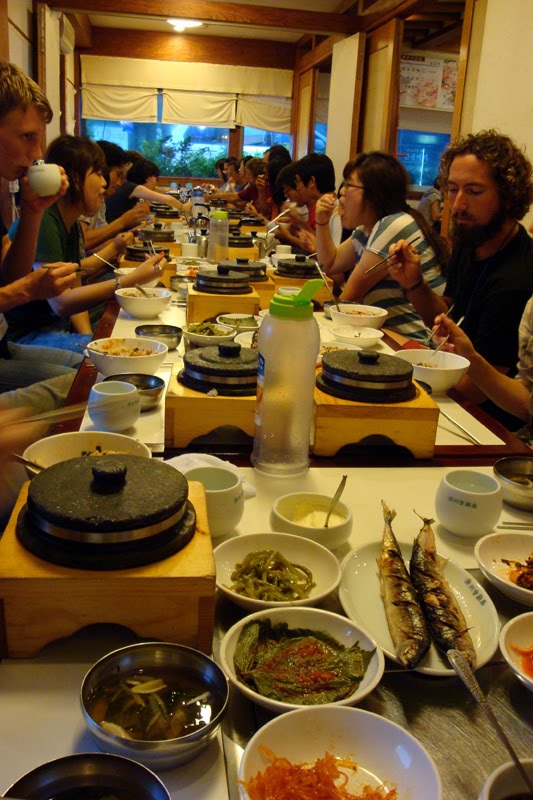


Bibimbab!

Tomo

Day 1 (July 10, 2010)

So right before our plane took off for Jeju one of the lead architects Kyle, told me that ithe island was known for three things: wind, stone, and women ( they are supposed to be very independent). Well he got at least one thing right! As soon as I stepped off the plane I was blown over by the wind. After we got in I met up with two other students from my trip. Our personal driver (hehe yes we have one for the entire trip) took us to the hotel. On the way we think he told us that today we are going to try Korean fried poodle. I’m hoping we misunderstood his English! Later that afternoon we went for lunch. It was yummy but not for the faint of heart. We had whole fish and octopus soup. Then we went back and got our rooms and roommates. We are living very traditionally. Shoes off at the door and no beds. We sleep on the bamboo floor so it makes sense to take our shoes off in our room! We then had a ceremony welcoming us to South Korea. We have Americans,a mexican, a filipinos, Koreans, Chinese,a japanese, and Russian students. We then had a feast! Literally. We had a buffet of at least 30 different choices of seafood, veggies, rice, and fruit. I wasn’t quite sure what I ate but it was pretty good! After dinner the students all hung out. Although the language barrier is difficult we are becoming fast friends. Korean girls are big fans of twillight and they are team jacob all the way. I also am teaching them flip cup and beer pong today! Speaking of which Today we are going to visit politicians. We are acting as diplomats from our countries so its pretty cool! That’s about it and cross your fingers for me that I don’t have to eat fried poodle. Much love.

- Jordan

Wednesday, July 7, 2010

The 2010 Pacific Rim Park Project: Members' Introductions

The 2010 PRP Project is just around the corner!

Before moving on, let me introduce myself. My name is Tomo Ito, and I am currently studying International Relations/Pacific Studies at University of California, San Diego. I will be participating in the PRP mainly as a filmmaker/blogger. If you see someone with a video camera, that is probably me! I hope everyone will not be camera-shy!

The first blog for this year's PRP will be to introduce the participants with pictures. Here we go:


Mr Kyle Bergman
New York, NY
USA


Ms Jordan Kravitz
University of Cincinnati
USA


Mr James Hubbell Julian
Califorina USA


Mike Meo
Hampshire Collage
USA


Mr Garrett Goodwin
University of Hawaii
USA


Ms Sae Bom Lee
Dankook University
South Korea


Ms So Hee Choi
Yonsai University
South Korea


Ms Hee - Jae Hyun
Jeju National University
South Korea


Ms Eun Ji Son
Han-Yang University
South Korea


Mr. Kyoung Keun Park
Han-Yang University
South Korea


Ms Jin Park
Hankook University of Foreign Studies
South Korea


Mr Ji Su Park
Han-Yang University
South Korea


Mr. Valery Savostenko
Far Eastern State Technical University
Russia


Ms Catherine Doymina
Far Eastern State Technical University
Russia


Ms. Claire Lilang
Palawan State University
Philippines


Mr. Dimitry Steblyakov
Far Eastern State Technical University
Russia


Mr. Galel Hernandez
Universidad Iberoamericana
Mexico


Ms Wang Ziyang
Yantai University dept of Architecture
China


Mr. Tomohiro Ito
University of California, San Diego
Japan


Ms. Zhu Xuejiao
Yantai University dept of Architecture
China


Mr. Xu Kuo
Yantai University dept of Architecture
China


Ms. Gao Yan
Yantai Foreign Affairs Translator's
China


Also, here are the list of other participants who did not submit their pictures as of today.

Mr. Pablo Lim
Holy Trinity University
Philippines

Ms Seung-Ji Han
Jeju National University
South Korea

Ms Sun-kyoung Shin
Jeju National University
South Korea

Mr Jae-Hyeong Kim
Jeju National University
South Korea

Mr Hyun Oh
Jeju National University
South Korea

Ms Yu-Ri Kang
Jeju National University
South Korea

Ms Hyeon-Jin Song
Jeju National University
South Korea

See you soon!

Tomo

Tuesday, June 29, 2010

The 6th Pacific Rim Park Project will begin on July 11th. This years group will be made up of Koreans, Chinese, Japanese, Mexicans, Russians, Philippians and Americans. If you want to follow the progress we will be blogging everyday.

Kyle

Thursday, July 9, 2009

A blog entry from Tukhbatulin Anatoliy of Russia

Anatoly shares his thoughts....

“PACIFIC RIM SALINLAHI PARK”

Целый месяц команда преподавателей и студентов Института архитектуры искусства и дизайна провела на Филиппинах. С 5 по 30 мая 2009 года в г. Пуэрто-Принцеса международный коллектив из пяти стран (Россия, США, Китай, Филиппины, Южная Корея) возводил парк дружбы и сотрудничества народов тихоокеанского региона “Pacific Rim Salinlahi Park”. Россию представляла группа из 5 человек - преподаватели Анатолий Николаевич Тухбатулин и Алексей Валерьевич Парняков, студентки Ольга Зверева и Александра Моторина, а также выпускница ВУЗа архитектор Елена Гончарова.
Это уже пятый парк, в воплощении которого ДВГТУ принимает непосредственное участие. Ранее были построены парки в г.Владивостоке, 1994 г.; в г.Сан-Диего, США, 1998 г.; в г.Янтай, 2001 г.; в г.Тихуана, Мексика, 2004 г.
Во Владивостоке парк «Души и земли», первый из серии парков, располагается на территории Дальневосточного государственного технического университета, рядом с видовой площадкой у Молодёжного центра ДВГТУ.
Филиппинский парк представляет собой композицию из малых архитектурных форм. Главным элементом композиции является шестиметровая сферическая арка – символ ворот или окна в океан. Одна из стен арки словно волна обнимает жемчужину, выполненную в мозаике. Уровни террас и ступени отделаны природными камнями разного цвета и формы, создавая на поверхности своеобразный орнамент. Другими элементами парка являются пергала, скамьи для отдыха и тропа, связывающая парк с береговой зоной. Фрагменты цветной мозаики присутствуют на различных элементах парка. Территория озеленена плетущимися и другими декоративными посадками, а высаженные деревья создадут приятную тень в местах отдыха посетителей.
Немало трудностей поджидало участников в процессе строительства – это и тропический климат с палящим солнцем и проливными дождями, и назойливые москиты, и трудовые мозоли. Тем не менее, парк был построен в срок. Даже дождь не омрачил церемонию открытия монумента, на которой присутствовал сам мэр города.
Строительство следующего парка запланировано в Южной Корее уже в 2010 году.

Приглашаем посетить наш сайт: www.prppearl.blogspot.com

Saturday, June 13, 2009

MEMORIES of the 5th Pacific Rim Friendship Park

More unseen photos of the group :)


To Jim and Kyle and to all the participants, I just want to say that its a big privilege to be your photographer and to document every single aspect of the Pacific Rim Salinlahi Park. Its not only the photographs that matters but the friendship I made with you all. Your dedication and enthusiasm will inspire me always.

Cheers to all your hardwork and for the job well done. :)
-SARAH

To see more photos of Puerto Prinsesa, Palawan click HERE

(photos taken using the Horizon Kompakt camera)

A blog entry from Patrick Manlangit of the Philippines


Patrick shares his thoughts.....


The Salinlahi Park of Puerto Princesa, Palawan, Philippines was true to its name in uniting different countries into one Pacific Rim. Salinlahi, is a Filipino word, which means, “One Race”, which is used in the Philippines for its diverse culture and influences that seeks to establish as one Filipino nation. It also fits in a broader perspective of the Pacific Rim countries, for it expressed the need for mutual friendship and shared cultural experiences among each nation.

The whole activity had provided us a new perspective in thinking and building ideas. In the design process, it gave us a different outlook in design unlike what we are used to do in the architectural school. It had taught us in broadening our creativity and searching for the “genius loci” or “feel of the place” that would best expressed the nature of Palawan, the Philippines and the Pacific Rim countries. Creativity and imagination came first and then the technical and scientific aspects followed which made our design much more creative and enriching. Moreover, the use of clay, as a tool in expressing our design in 3 dimensional, makes our design flexible and dynamic in the sense that both drawing and model interrelates with each other. In this way, it became an interactive way of learning and appreciation of the design in a scaled model.

The building process was the most challenging part of the program. It was my first time to experience real construction wherein we will be the one to build the design that we have made up. I also learned a lot from the experiences that goes beyond what the four-cornered classroom taught us. I appreciate the materials like the metal bars, level tool, the cement mixer and many other things that are necessary for the completion of the structure. I remembered what James Hubbell told us that, “The metal bars are the natural French curves in construction. They formed natural smooth curves.” I realized that in construction, it does not need to be rigid in the sense that, it will strictly follow what the plan said, but it is dynamic and flexible depending on what best suits the overall design.

It is not only the architectural knowledge and ideas that we have shared with one another, but also the richness of culture and mutual enjoyment we have experienced together as one Pacific. It gave me a fresh outlook on the different culture beyond the Philippines and learned to appreciate the diversity of different nations and build long-lasting friendship with our fellow Pacific rim countries.

Patrick Manlangit is a 3rd Year Bachelor of Landscape Architecture student of the University of the Philippines.